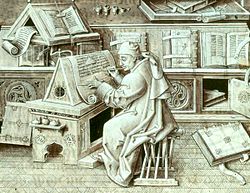
A Scriptorium (which literally means “a place for writing”) is a room in medieval European monasteries devoted to the copying of manuscripts by monastic scribes.
I’d like to share with you a language-learning technique that is not something I would personally prefer to use but I do think that it will suit a lot of personalities out there–if you’re a grammar nerd, or really feel like you have to learn the formal grammar and syntax of a language to actually learn the language itself, then this is for you.
I don’t take a side in this argument, I don’t think there should be an argument: it’s simply a matter of different personality types and what works best for you. The two extreme opposites here are people like me and Benny who hate any kind of formal classroom-like learning and just prefer to speak, speak, speak and sort of learn as we go, then there are people like Professor Arguelles (who speaks 13 different languages and is certainly no slouch), Randy, and Iversen on HTLAL who much prefer to learn the formal grammar and syntax of a language so that they can really get a ‘feel’ for the structure of it and this allows them to effectively put everything together and truly understand the language, which is fine, too. Whatever works most effectively for you is what you should do.
The Scriptorium Method
What is the Scriptorium Method? This is something that Professor Arguelles developed and currently teaches to his students that forces you to really focus on every last little detail of the language as you’re transcribing these sentences, you learn vocabulary and grammar all at the same time, and since it’s so focused you learn a great deal of it in a relatively short amount of time. The key here is to really take your time and focus on what you are doing. You will find that short sessions of about 15-30 minutes each are the most effective, as you simply cannot maintain the requisite level of focus for much longer than that.
The 3 basic steps that make up the essential Scriptorium method are:
- Take a sentence and read it aloud.
- Speak aloud again as you write it carefully.
- Read the sentence aloud from what you have written.
What you are essentially doing is transcribing a text in the language in question, but you’re not just doing that, because as you go along you must look up and make sure you fully understand any and all grammar related to what you are writing and any and all vocabulary that you do not fully understand. Do you see how you could easily spend 10 minutes on a single sentence? The point is that you must FULLY understand EVERYTHING that you are writing, and you will do absolutely anything and everything necessary (up to and including contacting native speakers over the internet to help you, or a local one if you know one) to make sure that you do. Now, if you were to do this and go through just, say, 10 pages of a normal (adult reading level) non-fiction book in the language that you’re learning, do you see just how much you would learn??? An enormous amount. This isn’t my style, but that’s certainly not to say that it isn’t effective.
Demonstration Video
Here you can see Professor Arguelles doing a short demonstration of the Scriptorium method; he goes into further detail and answers questions about it in this thread on HTLAL:
I learned to speak conversational Spanish in six months using TV shows, movies, and even comics: I then wrote a book on how you can, too
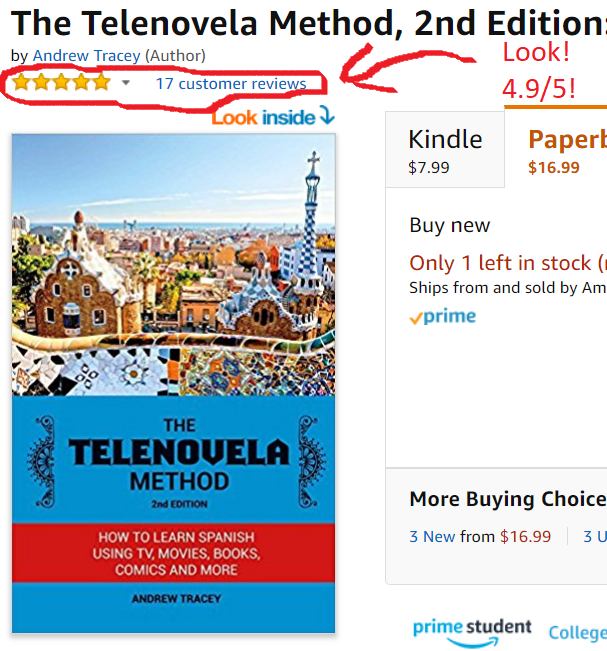
I have a whole method and a book I wrote about it called The Telenovela Method where I teach you how to learn Spanish from popular media like TV shows, movies, music, books, etc. that you can all find online for free. It was the #1 new release in the Spanish Language Instruction section on Amazon for nearly a month after it came out and currently has 17 reviews there with a 4.9/5 stars average. It's available for $7.99-$9.99 for the e-book version depending on who you buy it from (Kindle version on Amazon is now $7.99) and $16.99 for the paperback (occasionally a bit cheaper, again, depending on who you buy it from).
It's currently available in both e-book and paperback from:
Cheers,
Andrew