 There are essentially two language learning styles that people have, and it’s not necessarily black or white, but they will typically have a preference for one or the other, usually a strong preference: global or linear.
Most language teachers, in schools anyway (ESLs are different, usually in a good way), use a linear, or sequential, method. They treat foreign languages like mathematics: you can’t learn X until you’ve learned the step that came immediately before it, and you can’t learn that until you learned what came immediately before it, etc. Now, foreign languages are not like mathematics: once you’ve got a small, minimum base, a foundation, of necessary information, you can go anywhere from there and skip around to your heart’s content. You’ll manage, believe me. Look, you didn’t learn sequentially (in a linear fashion) when you learned your native language as a child, did you? You don’t need to now, either, and it’s not the best way, either. Get a minimum amount of information (very basic grammar and vocabulary of, say, the 1oo or 200 most commonly used words, for example) and then just go nuts, listen to everything: newscasts, radio, TV shows, etc. Talk to native speakers! Remember how important that is? You can do that with very, very minimal learning in your target language.
If you’re the left-brained, analytical type and you’re really, really stuck in your ways, then I suppose doing it that way is better than not doing it at all, but I would beg you to let it go and try doing learning globally instead. If you’ll try it for a week or two I think you’ll find that your results are more impressive than if you had continued on in your usual formal, sequential style for the same amount of time instead.
People who have no formal training whatsoever and take no language classes get immersed in a country for a year and come back fluent (able to fluently speak, comprehend, read, and write), whereas people who have been taking formal classes in the language in question for years still can’t do a quarter of what that person can after only a year’s immersion in-country. What does that tell you??? There’s a reason for that!
Even the scientific, super-analytical Iversen on HTLAL, who’s learning style is the exact opposite of mine (he prefers memorizing vocabulary from lists, learning from formal grammars, etc.) prefers a global learning style to a sequential one.
I learned to speak conversational Spanish in six months using TV shows, movies, and even comics: I then wrote a book on how you can, too
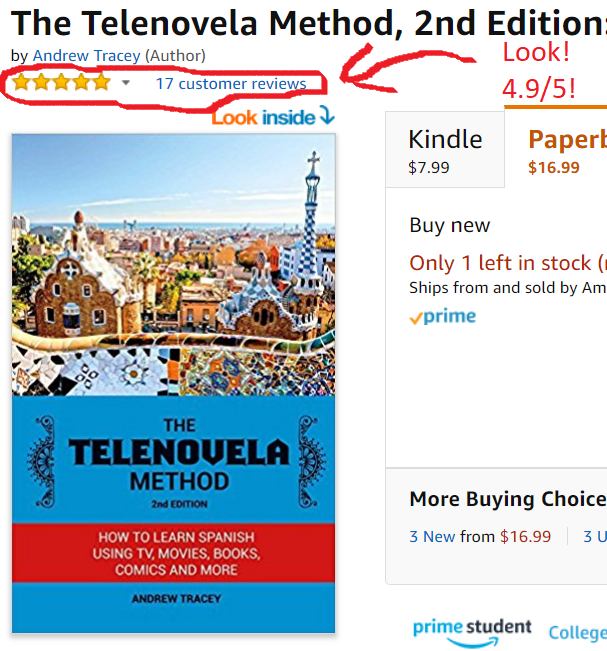
I have a whole method and a book I wrote about it called The Telenovela Method where I teach you how to learn Spanish from popular media like TV shows, movies, music, books, etc. that you can all find online for free. It was the #1 new release in the Spanish Language Instruction section on Amazon for nearly a month after it came out and currently has 17 reviews there with a 4.9/5 stars average. It's available for $7.99-$9.99 for the e-book version depending on who you buy it from (Kindle version on Amazon is now $7.99) and $16.99 for the paperback (occasionally a bit cheaper, again, depending on who you buy it from).
It's currently available in both e-book and paperback from:
Cheers,
Andrew