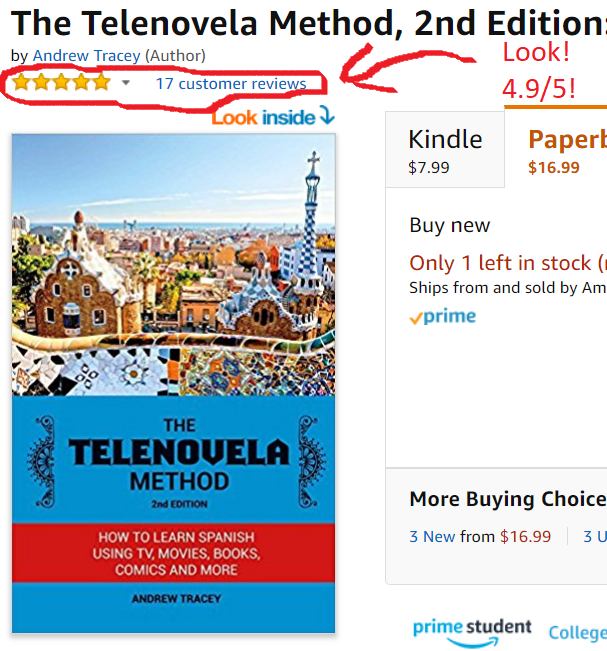
I show you how I use fun and interesting Spanish media like music videos, TV shows, and movies to learn Spanish.
Random header image... Refresh for more!

Learning Spanish with Comics

learn spanish from comicsI’ve got a short guest post here from someone whose site I’ve recommended before (I put it under my recommended links section in the sidebar), I’ll let him explain what they do:

At eLanguageSchool.net we are teaching people how to learn Spanish with
Comics
. You can read the comic in Spanish, then click the speech
bubbles to reveal the English translation. So far we have gotten very
positive feedback that it is a useful tool to practice reading
Spanish.

The entire project is a Creative Commons project, and we are looking
for volunteers to help translate and make the comics interactive. Here
are the steps involved to make what you see.

Step 1: Someone translates the comics from English, into Spanish (and
other languages). The translators simply write the translation on a
text document with one line per speech bubble, and a line between
pages.

Step 2: Someone opens up the comic book pages in an image editor, and
cuts out the speech bubbles and whites out the text. That way they are
just blank speech bubbles.

Step 3: Someone takes the translation, and fits them into the speech
bubbles, again in a text editor.

Step 4: Someone takes the translated speech bubbles, and overlays them
with the the original comic book page. This involves finding the exact
horizontal and vertical position to perfectly overlap the speech
bubbles.

You can see the finished result on the website. So far, we have
translated the first chapter of the comic into Spanish and French. If you would
like to volunteer in any of those steps, please email me, James, at
JDDunn9 – at – gmail.com.

The secrets of how to use free online resources to teach yourself Spanish, from home, in just a few months - Also: Here are the internet's Top 33 free online Spanish-learning resources

I run a newsletter entirely about how to learn Spanish online for free where I send out every cool new tip and technique that I learn to my subscribers and not only do they get it before anyone else but frequently they get things that no one else ever does. Additionally, I've spent a great deal of time putting together a 3-part series of articles for you on the internet's best free resources for the Spanish-learner that you'll get when you sign up for my newsletter--in addition to all of what you get below, I'll be sure to send you any updates about cool new sites, resources, and learning tips and techniques that I come up with:

Part 1: An article called “Spanish Learning Systems: Should you bother?” about whether or not you should even bother with a pre-packaged Spanish-learning system (e.g. Rosetta Stone or Pimsleur) and, if you do decide you want to, where you can go online to find programs that are literally 1/10th the price of older, more common systems like Rosetta Stone and Pimsleur but actually work even better. Also, at the same time, you’ll get a separate e-mail with a very long list of my favorite Top 33 free online Spanish-learning resources (tools, references, sites with free lessons, articles, blogs, forums, etc.) that's far to long to include here, especially with all the other stuff I've got below that's just on this site alone, and I'd like to offer it to you (completely free, you don't have to do anything other than sign up) right now.

Part 2: I explain what language exchanges are (essentially they allow you free access to an unlimited number of native speakers to practice your Spanish with), why they're absolutely essential if you're teaching yourself (I'm serious when I say this: it's impossible to get fluent without them if you're learning a foreign language on your own), how to use them, and which ones are the best.

Part 3: I cover chat rooms which are specifically devoted to connecting you with native Spanish speakers who want to learn English so you can chat with them in Spanish (and they'll help and correct you) and then you do the same for them with their English (these are completely free to use, but rather hard to find, but I'll tell you where the best ones are!). Sign up below!


Also, if you like what you see here PLEASE SUBSCRIBE to my Twitter feed and/or RSS feed so you can be updated any time there’s a new post.

Cheers,

Andrew

Related Posts:

September 27, 2011   No Comments

Reboot! How to Restart Your Language Learning after Slacking Off

And today I’ve got my first guest post ever!  From J. over at Polyglottally, he addresses something that every language-learner has done at some point and then had to deal with…

Oh dear, you’ve fallen off the language learning wagon.

You were tired, so you took a day off. The next day you were swamped and didn’t get around to it. The day after that you forgot your cue cards at home. Next thing you know, it’s been a month and you’ve made zero progress on your language studies. How embarrassing.

You want to get back into it, you want to learn more, but now you have feelings of a) guilt for having slacked off for so long, and b) despair at the thought of having to relearn what you may have forgotten.

Well, my fellow depressed language learners, here’s how to climb back on that wagon with gusto, seize those reins, and steer yourself back on course!

(Note: I fully endorse giving yourself a full day off for a personal retreat. Go ahead, call in sick or tell your boss you’re at an all-day off-site meeting. Escape to your favourite cafe or shady tree. You deserve it.)

Step 1: Release

Absolve yourself of the guilt, release yourself from past obligations. If you continue to kick yourself for what you haven’t done, you’ll constantly be mired in the past. You can’t change the past, but you do have full power over what you choose to do right now. That’s what counts.

It’s hard to forgive yourself sometimes, especially when you think back to all that precious time you wasted playing World of Warcraft when you could have memorized the Devanagari script and be reading Hindi fluently by now. No matter, what’s done is done. Once you’ve fully forgiven yourself, then you are ready for step 2 (and perhaps another lattÈ).

Step 2: Remember

Why did you start out on this language learning quest anyway? Remember what your motivations are and place them front and centre in your brain. Like Andrew previously wrote, motivation is the most important factor in learning a new language.

It is often easy to lose sight of why we began, especially when we get bogged down in the details of case endings and verb conjugations. Remind yourself of the reason why you are trying to learn French, Spanish, Greek, Klingon, et cetera. It could be for the love of travel, the love of food, the love of the intellectual challenge, or the love of your significant other. Whatever your motivation, bring it back to the forefront of your mind.

Write down your motivation in large block letters, tack it to the wall in front of you, then order another fudge brownie and continue to step 3.

Step 3: Refocus

What is your goal? What does “success” mean to you? It’s incredible how far off course we can get when we don’t know where we are going. If, after some soul searching, you realize you only want to be able to order food in a restaurant, then why are you reviewing vocabulary for negotiating business deals?

Some quick questions to ask yourself to gauge your definition of success:

  • Where and with whom do you imagine using the language?
  • What level of grammatical perfection do you need? Are you writing a doctoral dissertation, or are you chatting in the bar with friends?
  • What is the minimum you can get away with right now?

Focusing on your goal will tell you what you need to learn and, more importantly, what you can ignore for the moment. Your goal may very well change and increase as you approach it, which is the sign of intentional learning. But for the moment try to describe as accurately as possible what your goal is right now. Putting a timeline on it is also a good idea, but don’t stress yourself out. Write it all down, then go to step 4.

Step 4: Review

You probably remember more than you think. It may take a bit of gentle stretching to eke it out of your brain, but don’t despair: You’re not starting over from scratch.

Go through the table of contents in a grammar or phrase book, see what you know. Try translating whole conversations in your head, especially as they relate to your goal (see step 3). Gather the entire corpus of your knowledge together to remind yourself of how far you’ve come. This will not only act as a general review, it will also encourage you to see how much you already know, and hopefully reignite new interest in the act of learning the language.

Step 5: Recalibrate

Often we splash about without any real plan of what to do next. We jump on anything interesting that comes along, whether or not it helps us move towards our goal. When it turns out to be unrelated or irrelevant, we will soon forget all about it and will have then wasted our time.

Take the results from step 3 and step 4. Imagine you are looking at a big map. Where are you now? And where do you want to be? The gap in between will give you an indication of what to do next. Write down what you are missing, and this becomes your learning plan for the next little while. It’s as simple as that. Time for more coffee.

Step 6: Repeat

At the end of this personal retreat, you will have your goal and motivating force clearly articulated, you will have a summary of your past accomplishments, and you will have a game plan for what to do next. But now that you’ve forgiven your past transgressions, how do you avoid falling off that wagon again?

The answer is to conduct frequent reviews. I recommend “New Moon resolutions” (as opposed to New Year’s resolutions): the shorter time frame and higher frequency means you will have more opportunities to refresh and recalibrate your actions. Every 28 days, go through this exercise again to reinvigorate yourself, whether you feel you need it or not. The iterative process will ensure you are on track and on target. Calling in sick every month is entirely optional.

Best of luck,
J.

A Final Appeal to Language Enthusiasts

If you value language learning, and if you believe teaching languages to children is incredibly important, then please help me by voting for my project on Pepsi’s Refresh Everything grant competition. Visit my page, register with the site, and then vote as often as they will allow you! Tell all your friends, too. You can also read more about the project on my blog.

Quick edit from Andrew:

The secrets of how to use free online resources to teach yourself Spanish, from home, in just a few months - Also: Here are the internet's Top 33 free online Spanish-learning resources

I run a newsletter entirely about how to learn Spanish online for free where I send out every cool new tip and technique that I learn to my subscribers and not only do they get it before anyone else but frequently they get things that no one else ever does. Additionally, I've spent a great deal of time putting together a 3-part series of articles for you on the internet's best free resources for the Spanish-learner that you'll get when you sign up for my newsletter--in addition to all of what you get below, I'll be sure to send you any updates about cool new sites, resources, and learning tips and techniques that I come up with:

Part 1: An article called “Spanish Learning Systems: Should you bother?” about whether or not you should even bother with a pre-packaged Spanish-learning system (e.g. Rosetta Stone or Pimsleur) and, if you do decide you want to, where you can go online to find programs that are literally 1/10th the price of older, more common systems like Rosetta Stone and Pimsleur but actually work even better. Also, at the same time, you’ll get a separate e-mail with a very long list of my favorite Top 33 free online Spanish-learning resources (tools, references, sites with free lessons, articles, blogs, forums, etc.) that's far to long to include here, especially with all the other stuff I've got below that's just on this site alone, and I'd like to offer it to you (completely free, you don't have to do anything other than sign up) right now.

Part 2: I explain what language exchanges are (essentially they allow you free access to an unlimited number of native speakers to practice your Spanish with), why they're absolutely essential if you're teaching yourself (I'm serious when I say this: it's impossible to get fluent without them if you're learning a foreign language on your own), how to use them, and which ones are the best.

Part 3: I cover chat rooms which are specifically devoted to connecting you with native Spanish speakers who want to learn English so you can chat with them in Spanish (and they'll help and correct you) and then you do the same for them with their English (these are completely free to use, but rather hard to find, but I'll tell you where the best ones are!). Sign up below!


Also, if you like what you see here PLEASE SUBSCRIBE to my Twitter feed and/or RSS feed so you can be updated any time there’s a new post.

Cheers,

Andrew

Related Posts:

March 3, 2011   1 Comment

Awesome List of Free Spanish-Learning Resources

I just did a guest post over on Jennie’s blog (which is fantastic, you definitely should subscribe, by the way) where I listed my absolute favorite free Spanish-learning resources: check it out here.  I should note that, as I said in that post, I only included about 10% of all the stuff I’ve got bookmarked and saved, but it’s the very top 10%, I didn’t want to make it a ridiculously long post and waste people’s time with every imaginable resource and tool.

Let me know what you think in the comments (on her site or here)–also, I submitted it to StumbleUpon, if you’ve got an account I’d very greatly muchly appreciate a thumbs up on it.

The secrets of how to use free online resources to teach yourself Spanish, from home, in just a few months - Also: Here are the internet's Top 33 free online Spanish-learning resources

I run a newsletter entirely about how to learn Spanish online for free where I send out every cool new tip and technique that I learn to my subscribers and not only do they get it before anyone else but frequently they get things that no one else ever does. Additionally, I've spent a great deal of time putting together a 3-part series of articles for you on the internet's best free resources for the Spanish-learner that you'll get when you sign up for my newsletter--in addition to all of what you get below, I'll be sure to send you any updates about cool new sites, resources, and learning tips and techniques that I come up with:

Part 1: An article called “Spanish Learning Systems: Should you bother?” about whether or not you should even bother with a pre-packaged Spanish-learning system (e.g. Rosetta Stone or Pimsleur) and, if you do decide you want to, where you can go online to find programs that are literally 1/10th the price of older, more common systems like Rosetta Stone and Pimsleur but actually work even better. Also, at the same time, you’ll get a separate e-mail with a very long list of my favorite Top 33 free online Spanish-learning resources (tools, references, sites with free lessons, articles, blogs, forums, etc.) that's far to long to include here, especially with all the other stuff I've got below that's just on this site alone, and I'd like to offer it to you (completely free, you don't have to do anything other than sign up) right now.

Part 2: I explain what language exchanges are (essentially they allow you free access to an unlimited number of native speakers to practice your Spanish with), why they're absolutely essential if you're teaching yourself (I'm serious when I say this: it's impossible to get fluent without them if you're learning a foreign language on your own), how to use them, and which ones are the best.

Part 3: I cover chat rooms which are specifically devoted to connecting you with native Spanish speakers who want to learn English so you can chat with them in Spanish (and they'll help and correct you) and then you do the same for them with their English (these are completely free to use, but rather hard to find, but I'll tell you where the best ones are!). Sign up below!


Also, if you like what you see here PLEASE SUBSCRIBE to my Twitter feed and/or RSS feed so you can be updated any time there’s a new post.

Cheers,

Andrew

Related Posts:

January 28, 2011   No Comments